MICROSCOPIC EVOLUTION / 03
ViruS
MEETFUSE
EVOLVE
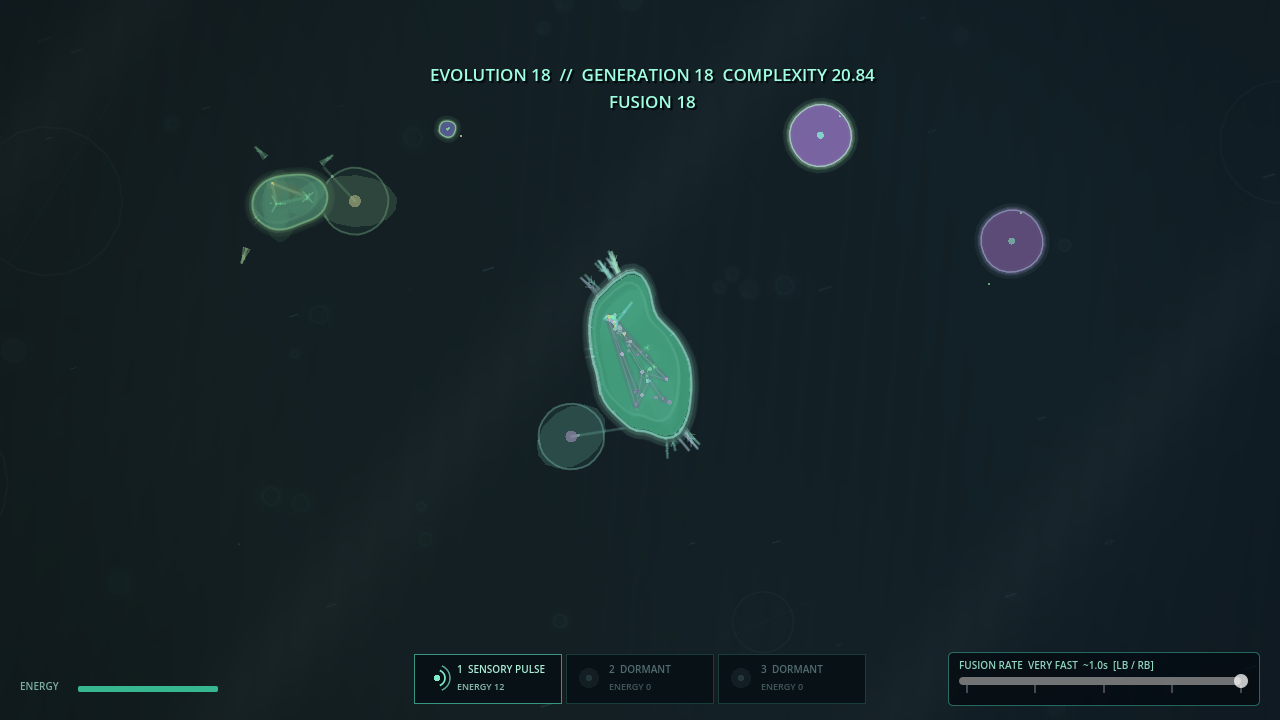 REAL GAMEPLAY / PROTOTYPE / 03
No final form. No repeated path.
DETERMINISTIC RULES.
DIVERGENT LINEAGES.
ViruS is a Godot 4.7 prototype written in typed GDScript. Seeded generation builds the microscopic world, genomes and organism behaviours, while an open morphogenesis system resolves inherited anatomy into a live visual and collision rig.
THE PROTOTYPE / 03
ViruS is a microscopic evolution game prototype in development. Its playable world is a frame for an open morphogenesis experiment: organisms meet, fuse and recombine into new connected bodies generated from lineage history rather than selected from a fixed catalog.
01Open-ended fusion and morphogenesis
02Generated anatomy carried across lineage history
03Infinite microscopic world with living populations
04Deterministic rules producing distinct evolutionary runs
- 01EXPLORE
Move through an unbounded microscopic field populated by organisms generated from deterministic seeds.
- 02MEET
Encounter lineages carrying different genomes, body plans, behaviours and fusion histories.
- 03RECOMBINE
Fuse two histories and let the morphogenesis system build one new connected anatomy.
- 04EVOLVE
Continue the lineage without returning to a fixed creature catalog or a final prescribed form.
NOT A FINAL FORM.
A LIVING QUESTION.
ViruS is a game prototype in development, built to explore one central idea: what happens when evolution is the system itself, rather than a sequence of upgrades chosen from a menu?
The world, organisms and movement create the playable frame. The real subject is open morphogenesis — lineages meeting, recombining and continuing as bodies that are generated from their history instead of repeated from a catalog.
EVOLUTION
WITHOUT A CATALOG.
Two organisms do not unlock a predefined creature. Their lineages contribute material and structural rules, then the system builds a new connected anatomy. The result belongs to both histories, but is not a copy of either parent.
The goal was not to design a long list of creatures. It was to design rules capable of producing difference.
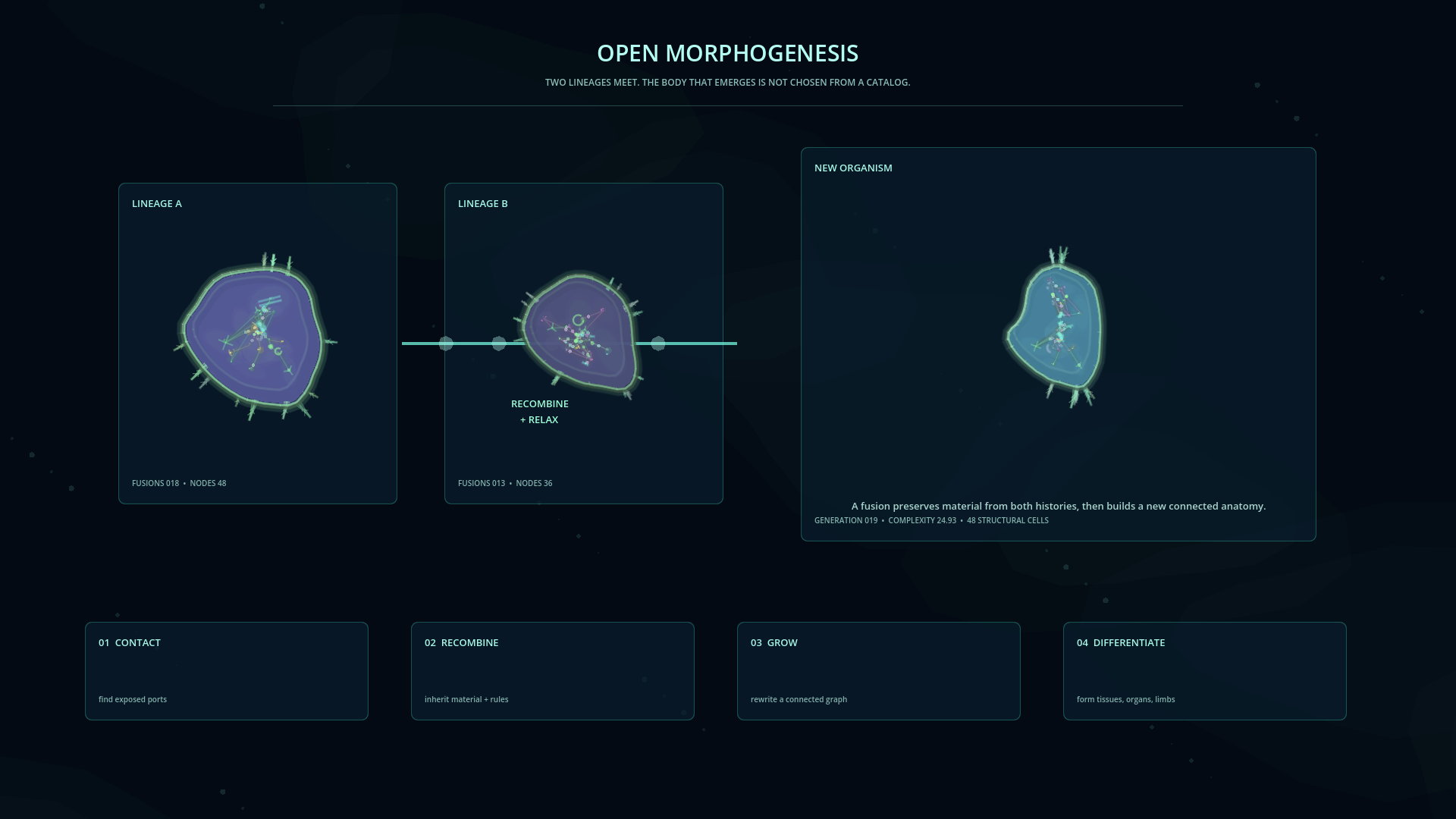
Two real lineages recombine into a new organism whose anatomy is assembled at runtime.
CONTACT → RECOMBINE → GROW → DIFFERENTIATEMEET.
RECOMBINE.
EMERGE.
The prototype lets evolution continue inside the living world. Organisms approach, connect and resolve into a new body while lineage memory keeps the transformation tied to everything that came before it.
- 01Inherited traits establish the starting material.
- 02Mutation and recombination change the anatomy graph.
- 03The visual rig grows a playable body from that structure.
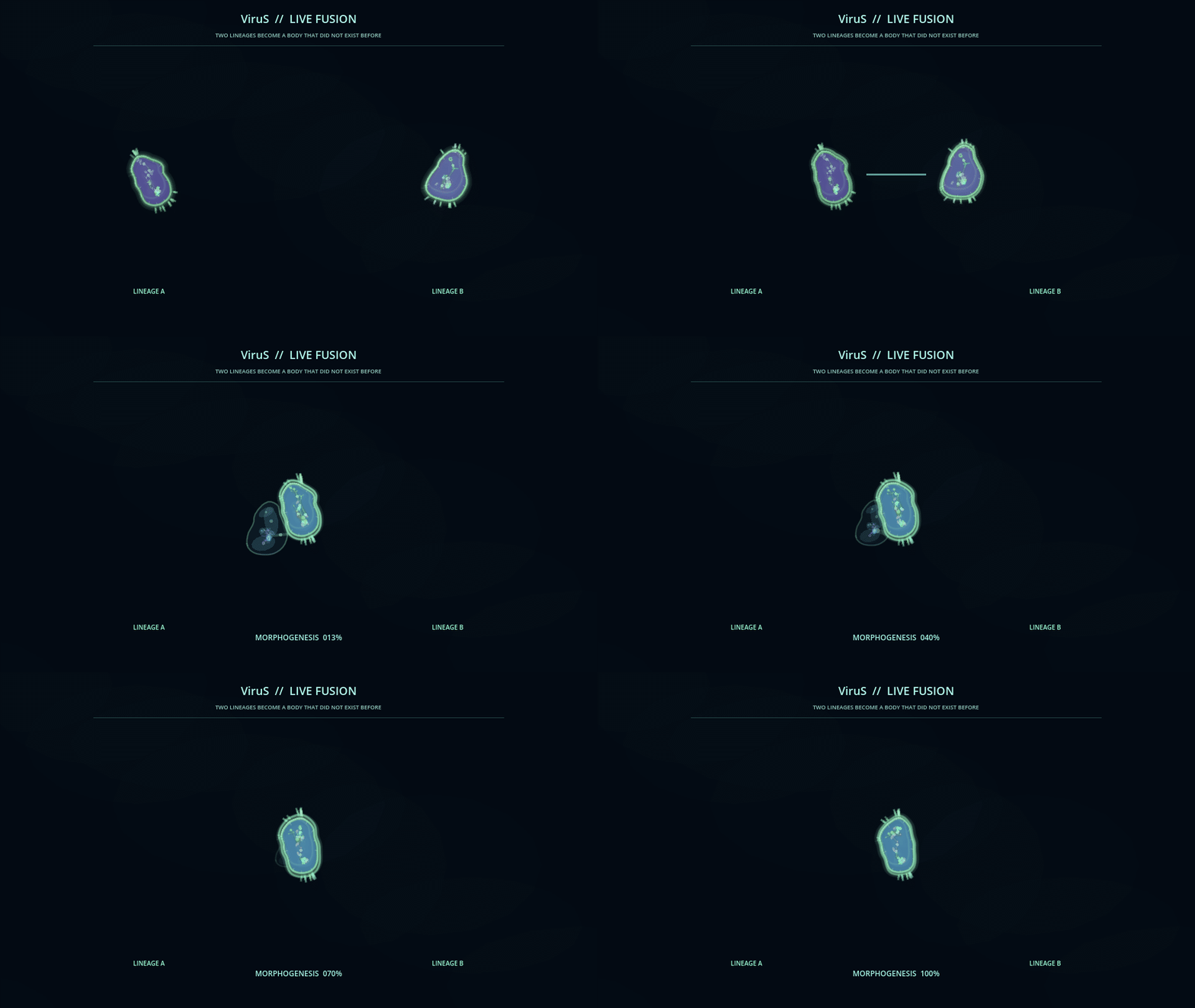
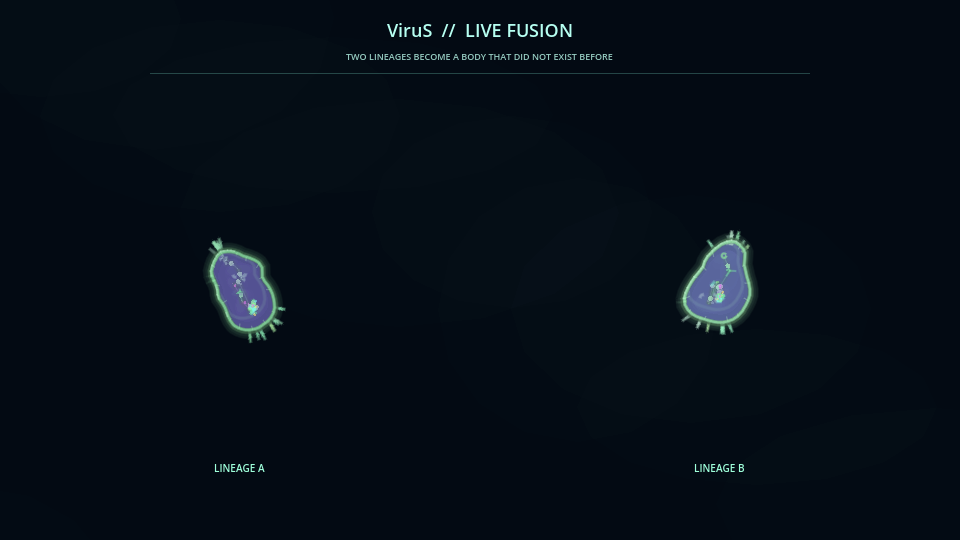
A captured runtime fusion: two lineages make contact and one new organism takes their place.
60 FRAMES / IN-ENGINEONE SYSTEM.
MANY HISTORIES.
Every run begins from a new seed. Each lineage then accumulates its own fusion history, so long-term form grows from a different chain of encounters rather than cycling through the same authored silhouettes.
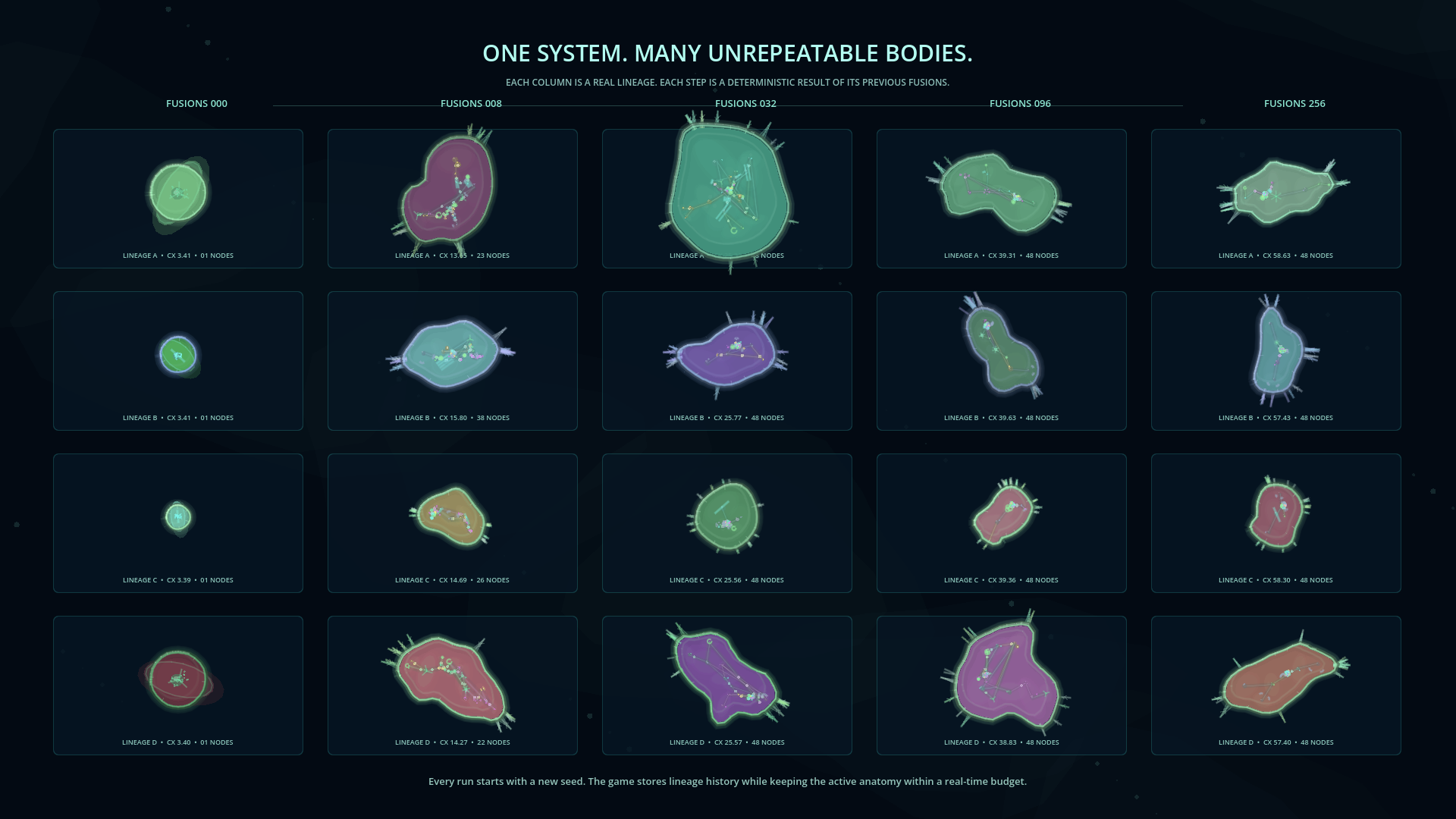
Independent runs diverge across 0, 8, 32, 96 and 256 fusions. The same tested rules produce visibly different bodies.
REAL GENERATION OUTPUTNO LAST
CREATURE.
The anatomy stays inside a real-time budget, but its history does not reset. The active body can remain efficient enough to move, collide and render while donor memory and lineage records preserve the path that created it.
ViruS is less about winning a level and more about watching a system surprise you without losing its internal logic.
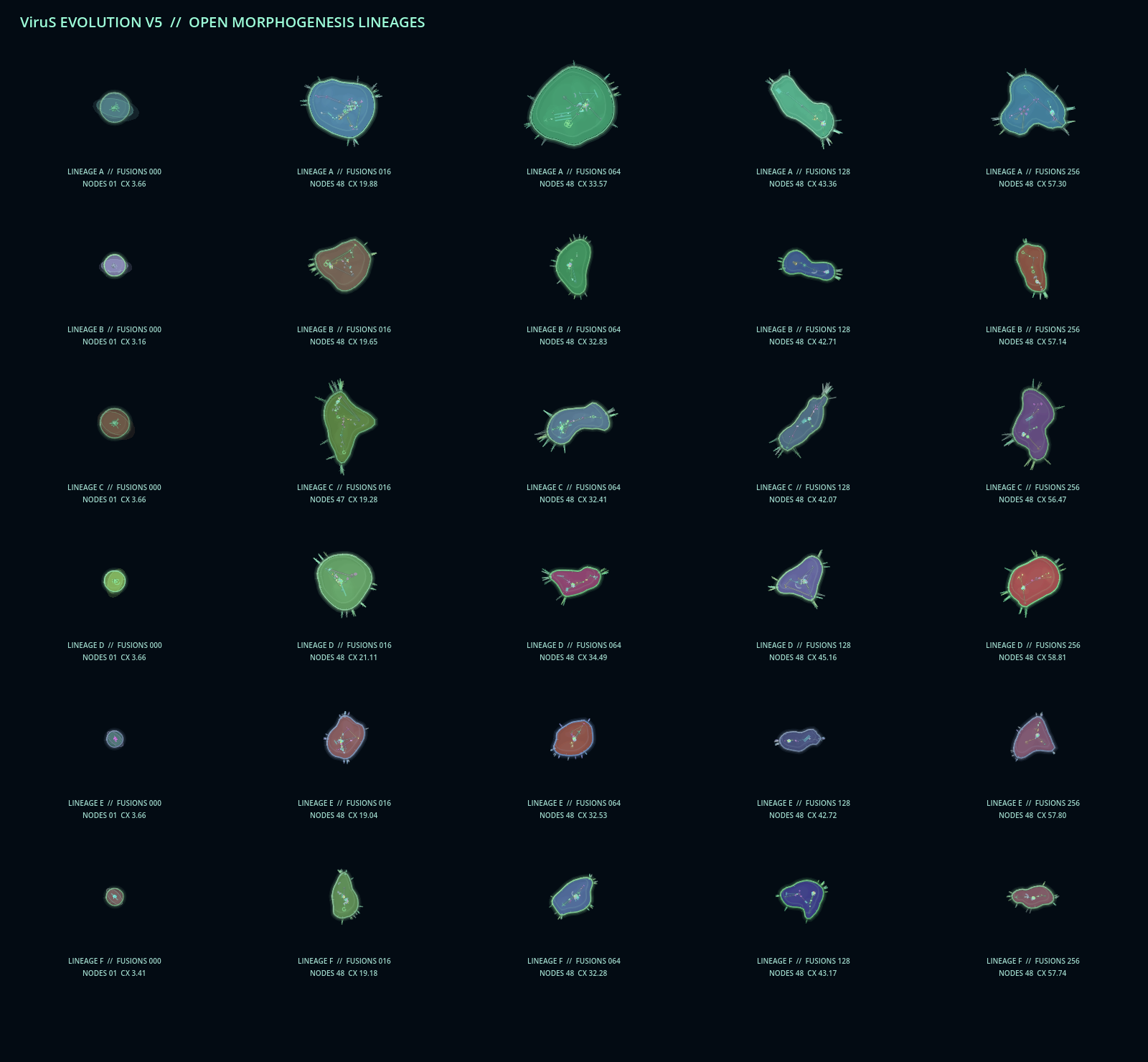
Six independent lineages recorded from their founding organism through 256 fusions.
0 / 16 / 64 / 128 / 256FOLLOW THE LINEAGE
ViruS is a prototype in development rather than a finished release. The repository documents the evolving Godot world, organism generator, fusion model and validation work behind it.
VIEW ViruS ON GITHUB ↗